Category: content-right

  • Ukraine

    Ukraine

    grieving woman

    The second invasion of Ukraine #118 by the Russian army, with news of the atrocities by Putin’s invading army, began in February of 2022, during the painting of the mural. The grieving woman entered the mural as a symbol of Hallowell’s support for the Ukrainian people.

    Slava Ukraini! Слава Україні!, “Glory to Ukraine!”

    The scenes of devastation from Ukraine are just heartbreaking. Though the Ukraine war is not central to Hallowell’s story, I needed to paint something. The crying woman cradling her child became a small but important part of the mural for me.

    artist, Chris Cart
  • Ebenezer Dole, abolitionist

    Ebenezer Dole, abolitionist

    first abolitionists

    Ebenezer Dole, #42, his brother Daniel and others, met here on November 18, 1833 and formed the first anti-slavery society in Maine known as The Hallowell Anti-Slavery Society.

    A year earlier Dole contacted William Lloyd Garrison, publisher of the Boston abolitionist newspaper The Liberator, and invited him to speak at Old South Church in Hallowell. When Garrison was jailed in Baltimore for his anti-slavery activity, Dole sent $100 to pay his fine and support his work. Dole was also a founding member of the Maine Anti-Slavery Society. James Gow, another Old South Church Deacon, is said to have provided asylum to the first fugitive slave who passed through Hallowell.

    (Excerpt from Historic Hallowell, museum in the streets.)

    Ebenezer and Hannah Dole House

    The Federal style home owned by Ebenezer #50 and Hannah Dole #42 can still be seen in Hallowell, Maine at the corner of Second and Lincoln Streets. Their home was also the site of the first abolitionist meeting in Maine.

    Ebenezer Dole House the corner of Second and Lincoln Streets
  • Declaration of Independence

    Declaration of Independence

    broad·sheet
    /ˈbrôdˌSHēt/
    noun
    a large piece of paper usually printed on one side only with information for public distribution; also broadside.
    Uses of the word date from the 16th century. In size most broadsides ranged from approximately 13″ x 16″ also known as “foolscap” size, to over 5 feet in length.

    rare 1776 broadsheet

    Mayor Robert Stubbs #20 is shown holding Hallowell’s rare, original 1776 broadsheet of the Declaration of Independence #21.

    The Continental Congress adopted the Declaration of Independence on July 4, 1776 and then ordered Ezekiel Russell, a printer in Salem Massachusetts to print 250 of these broadside copies of the Declaration for distribution around the colonies. Only 11 of these broadsheets are known to exist today.

    The broadsheets were circulated to churches and meeting halls across the 13 colonies. The broadsheets were to be read aloud so the citizens could know that America was declared sovereign lands, no longer under rule of the British monarchy.

    Three of these now rare documents were originally sent to Maine, one to North Yarmouth and one to Fort Western in what is now Augusta, Maine, but in 1776 was still part of Hallowell.

    According to one 1870 history of the region, the Fort Western copy was proclaimed throughout Hallowell and Gardiner, but apparently was never returned to Fort Western.

    The document disappeared for over 100 years, only resurfacing in 1908 when Hallowell native E.T. Getchell donated the broadsheet to the small museum in Hallowell’s Hubbard Free Library, what is now the children’s section of the library.

    found in the library

    Then the rare document had essentially disappeared again. However, in 1976, 200 years after the signing of the Declaration of Independence, our Hallowell historian Sam Webber #41, found the broadsheet, framed and tucked away in the library.

    The Hallowell broadsheet was loaned to Maine State Museum for an exhibit from 1990 to 1993. Later an agreement was reached for the document to be owned by the residents of Hallowell but permanently preserved anmd housed in the Maine State Museum.

    The rare broadsheet is estimated to be valued at $1.6 million.

    On rare occasions the document is brought to Hallowell for public display. Sandy and Bob Stubbs were instrumental in making this happen the last time on July 4, 2015. As part of the July 4th celebrations various Hallowell residents read from the broadsheet Declaration to a public gathering at City Hall.

    photo of Hallowell’s copy of the Declaration of Independence broadside.

    Elisa Clark Lowell

    Elisa Clark Lowell was a direct descendant of the Deacon Pease Clark #109, the family of European descent to build a home on Hallowell shores.

    In 1897 Elisa Clark Lowell donated $10,000 for an addition to the Hubbard Free Library to be dedicated as a small city museum. This is now the children’s section in the library. She attended the dedication the next year at the age of 97.

    Eliza then donated $20,000 to build a new City Hall, saying, “Build it strong that it may last for years to come.” While she saw it under construction, unfortunately, Eliza Clark Lowell died shortly before the building was dedicated in 1898. 

  • Hallowell Mayors

    Hallowell Mayors

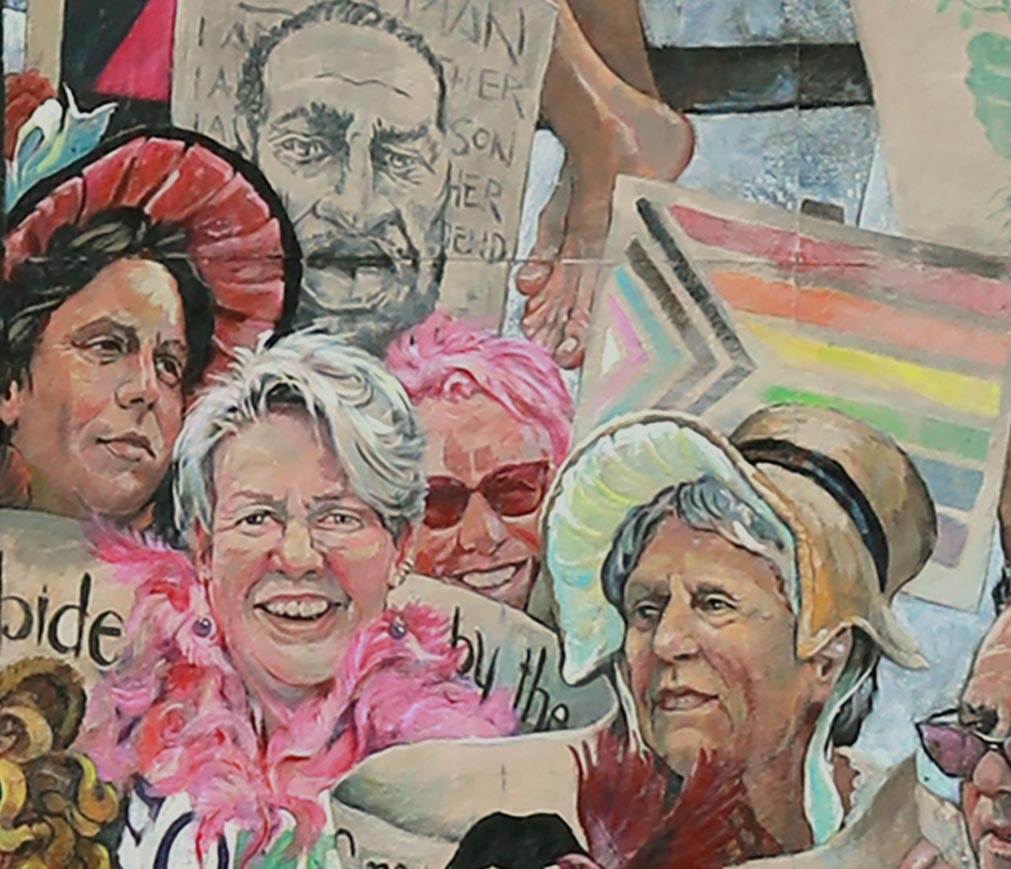
    Timson #17, Walker #18, Harmon #19, Stubbs #20,

    several key mayors

    Several recent Hallowell Mayors are shown here, Robert Stubbs, Harvey Harmon, Barry Timson, Mark Walker and George Lapointe.

    Mayor Robert Stubbs #20, is wearing a SAVE HALLOWELL t-shirt. In the 1975 Maine Department of Transportation wanted to widen Route 201 through Hallowell—an act that would have razed many of Hallowell’s historic downtown buildings. Stubbs, the mayor of the time was one of many Hallowellians, calling themselves The Patriots, who fought to preserve the downtown.

    Stubbs is also holding Hallowell’s rare, original broadsheet from 1776 of the Declaration of Independence. Only 250 of these copies of the new Declaration were printed and distributed around the new nation. This rare document was found framed in storage in the Hubbard Free Library in Hallowell. Hallowell’s copy of the Declaration of Independence is now housed at the Maine State Museum.

    I chose these mayors to represent the long list of Hallowell Mayors as they were considered to have contributed a lot to the city during their terms in office.

    artist, Chris Cart

    Mayor Barry Timson #17, was a pillar of the Hallowell community. He served 3 terms as mayor as well as years on the Planning Board, the Water and Sewer District Board, and the Hallowell Water District. He was instrumental in setting up Hallowell’s Head Start program and Hallowell Food Bank.

    Mayor Charlotte Warren #47 served as Hallowell mayor for 5 years. After that she served for four terms in the Maine House of Representatives. and 8 years on the Legislature’s Criminal Justice and Public Safety Committee. Warren previously served on the Judiciary Committee and as the house chair of Maine’s Mental Health Working Group and the house chair of the Commission to Examine Reestablishing Parole. Charlotte is a social worker and an educator.

    Mayor Mark Walker#18, a lawyer, was elected mayor of Hallowell in 2013 and serve 7 years in that position. Before his election, Walker had served on the City Council since 2006. During that time, Walker said that Hallowell has seen “a lot of change and a lot of development.”

    Mayor George LaPointe #68 was the mayor during the majority of the time the mural was being painted.

    Harmon D. Harvey #19, was mayor of Hallowell from January 1990 – January 1996. Then he served as Councilor at Large from January 1999 – January 2002 and prior he had served as Councilor for Ward Five from January 1977 – January 1987.

    Mr. Harvey oversaw the acquisition of the Jamies Pond Wildlife Refuge and was instrumental in arranging for the location of the William S Cohen Center in Hallowell.

    Charlotte Warren, #47 in the sun glasses behind Betsy Sweet #48 and Libby Thompson #46
    George LaPointe #68
  • those who serve

    those who serve

    national service

    Men and women of Hallowell have served in all the major wars in our nation’s history.

    Mark Francis Bastey, #24, US Army Major, served in Vietnam and received the Purple Heart. He was also awarded the Silver Star for gallantry in action and 2 Bronze Stars.  

    His dates of service are June 1969 to May 1984.  He was medically retired from the Army due to the MS diagnoses.  After retiring from the Army, Mark worked for the Maine Department of Labor as a Veteran’s Counselor.

    Ernest “Bev” Bevilacqua, #25, joined the Navy at 17 and served on several battleships as a gunner’s mate in World War II. He was blown off one into the sea. After the war his ship was stationed just 10 miles off Bikini during the nuclear testing.

    Bev was not from Hallowell but he was my dearest friend. He died in 2019. I included him young in his Navy cracker jacks as a memory.

    artist, Chris Cart

    Brian King #22, served in our modern era.

    Local models

    Diana Gibson, #43, a descendent of the Vaughan family, is shown in the mural. She served in the Red Cross in World War II.

    Of the many Hallowell men #23 who served in the Civil War 45 died fighting for the freedom of others. You can see the large obelisk monument for these fallen soldiers in the Hallowell cemetery.

    Diana Gibson, #43 in mural
    Civil War Memorial, Hallowell Cemetery
  • Governor Bodwell

    Governor Bodwell

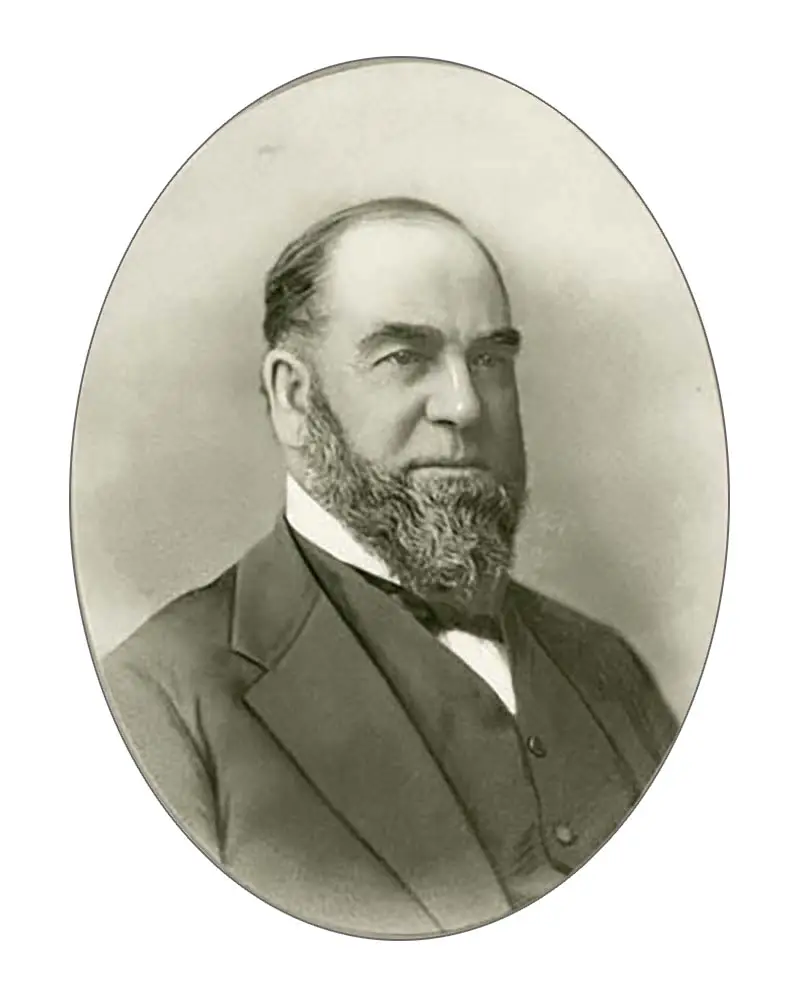
    Governor Bodwell in black coat with grey waistcoat.

    Joseph Robinson Bodwell | 40th Governor of Maine

    (June 18, 1818 – December 15, 1887) Politician

    Joseph R. Bodwell #16, was first elected Mayor of Hallowell in 1869 and served two terms.  He also represented Hallowell in the Maine legislature.

    In 1886 he was elected the 40th Governor of Maine, the second Governor from Hallowell.  While in office he advocated to improve child welfare and labor conditions for workers in Maine’s industries. He served until his death on December 15, 1887.

    Granite industry

    In his 20’s, Joseph Bodwell and his father bought and worked a farm in West Methuen, MA.  During this time period young Bodwell was also engaged to haul a large amount of stone from the quarries in Pelham, New Hampshire to improve the dam on the Merrimack River at Lawrence, MA.  This was his introduction to all aspects of the stone quarrying industry.

    Successful businessman

    Bodwell also had business interests in lumbering, agriculture, live stock and the important ice business.

    Bodwell eventually became the owner of two stone companies, opening granite quarries on Vinalhaven in 1852 and opening the Hallowell Granite Company in 1866.  The company was reorganized as the Hallowell Granite Works in 1885 becoming one of the largest granite producers in the United States.

    He is buried in the Hallowell Cemetery.

    Governor Bodwell Mansion is newly restored on Middle Street in Hallowell. This photo if c1900.
    Bodwell mansion as seen today.
  • Row House Inc

    Row House Inc

    Preserving Hallowell history

    Row House, Inc. #15 was incorporated in July 1969 by a small group of civic minded citizens who were determined to preserve Hallowell’s rich history as told through its buildings. The initial corporation’s eleven officers and trustees gave the seed money to purchase what was seen to be the most endangered historic property, the Gage Block.

    You can visit their website here for more information and to join and donate to their important cause: Row House Inc.

    Larry Davis #15, the president of Row House when the mural was created, is shown in the ballcap in the mid-distance.

    Row House was one of our very generous mural sponsors, so I included the Row House building of their logo in the mural.

    artist, Chris Cart

    Row House Mission

    Row House is a history-based community organization founded with two primary missions:

    • Historic preservation, that is, the preservation of historically significant structures in the City of Hallowell, together with advocacy on historic preservation issues.
    • Preservation and promotion of community history.
  • first car in Maine

    first car in Maine

    Judge Rice

    The first automobile #14 in Maine was made in Hallowell in 1858 at the McClench Machine Shop on Water Street. Hallowell residents, Judge Richard D. Rice and Dr. Hill, supplied the money and the automobile was built by George McClench, Frank McClench, and Charles L. Spaulding.

    The car was powered by a small, steam locomotive engine. They drove it to Augusta and back to the machine shop in Hallowell to be dismantled. (excerpt from Maine Memory Network.)

    We have no record of what the steam car actually looked like except the description that it was powered by steam and built out of a very rugged cart built for hauling granite—and that it was driven on its maiden, and only trip, by Judge Rice in his top hat.

    I studied other steam vehicles of the time to come up with this vision of how it might have looked.

    artist, Chris Cart

    Associate Justice of the Maine Supreme Judicial Court

    (April 10, 1810 – May 27, 1882)

    Justice Rice was appointed a Judge of the District Court for the Middle District in 1848. He was appointed an Associate Justice of the Supreme Judicial Court on May 11, 1852. He served until he resigned on December 1, 1863 to take the presidency of the Portland and Kennebec Railroad Company. He died in 1882 at the age of 72 in Augusta.

    For the mural, Judge Rice is portrayed driving the vehicle on its trip to Augusta, illustrating an account from the time in a local newspaper.

    Justice Richard D. Rice