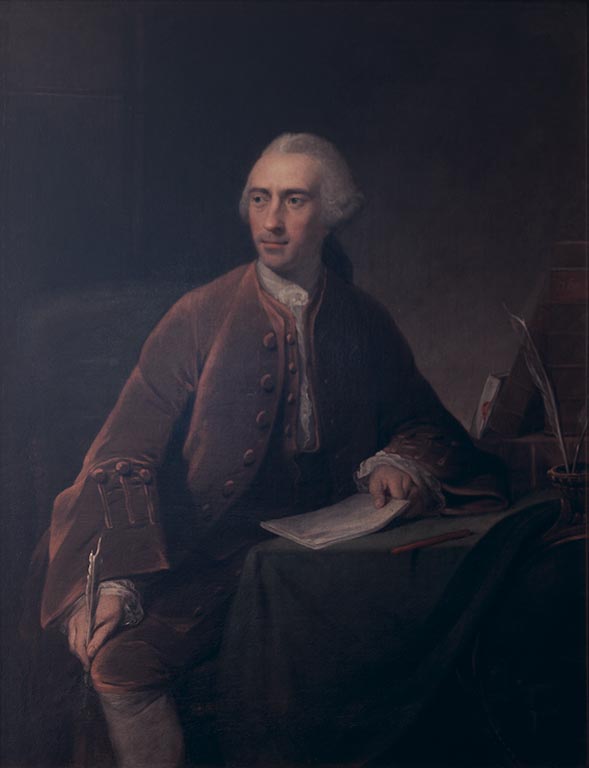
Benjamin Vaughan#6, and his brother Charles could be considered early “founding fathers” of Hallowell, Maine. While not the earliest of Hallowell settlers they were men of importance and influence who settled in the region in its formative days.
Benjamin Vaughan was friends with Benjamin Franklin and corresponded with Thomas Jefferson for many years, including during Jefferson’s presidency.
The Vaughan family home built in 1794 can still be seen and visited in Hallowell on the 194 acre property.
I painted Mr. Vaughan in the act writing a letter to President Jefferson to show his importance to the nation and influence with the nation’s founding fathers.
Artist, Chris Cart
Born in Jamaica, Benjamin moved to England with his parents Samuel and Sarah Vaughan shortly after his birth. Benjamin was educated in England, attending Trinity Hall, Cambridge and later studying medicine at University of Edinburgh.
He was a medical doctor, diplomat, political economist, merchant, a member of Parliament and British commissioner whose task was to smooth negotiations between Britain and U.S. during the drafting of the Treaty of Paris.
In 1805 he was elected a Fellow of the American Academy of Arts and Sciences. one of the oldest learned societies in the nation, founded in 1780 by several of our nation’s founding fathers including John Adams, John Hancock, and James Bowdoin.
An educated family
Benjamin Vaughan spent his early life in England until moving to Hallowell in 1794.
When Benjamin Vaughan moved his wife Sarah Manning and seven children from England to Hallowell, Maine in 1797, he brought his extensive library, which rivalled the library at Harvard University of the time with close to ten thousand volumes.
Vaughan brought Elizabeth Palmer Peabody to Hallowell as governess and educator to his daughters and sons. Vaughan wanted all his children to be well educated and capable thinkers.
Vaughan was beloved by Hallowell for his philanthropic efforts in the community.
The Vaughan family wealth came from the large sugar and coffee plantations on the island of Jamaica run by Benjamin’s father Samuel.
Portrait of Dr. Benjamin Vaughan, circa 1800, artist unknown.
I recently read a more detailed and interesting history of Benjamin Vaughan’s move to Hallowell. Vaughan was involved in the peace negotiations to end the American Revolution. In 1794 he was imprisoned for a short time in France, where he was suspected of being a British spy, narrowly escaping the guillotine. He eventually fled to Switzerland and then later in 1797 moved his family to Hallowell to take over the estate built by his brother Charles in 1794.
Artist, Chris Cart
Samuel Vaughan, painting by Robert Edge Pine – Government Art Collection, Public Domain, https://commons.wikimedia.org/w/index.php?curid=26142665
the Vaughan family legacy
There was some discussion with the Vaughan Woods and Historic Homestead organization about how to portray Dr. Benjamin Vaughan. While his personal connection and influence on early Hallowell was grandly beneficial, the family wealth was originally derived from his father Samuel Vaughan’s plantations on Jamaica, lands worked by hundreds of enslaved people.
Samuel Vaughan first made his way to Jamaica as an indentured apprentice. By 1747 records show Samuel Vaughan had long since fulfilled his apprenticeship and become wealthy enough to ask for the hand of Sarah Hallowell as his wife, daughter to Benjamin Hallowell for whom Hallowell, Maine is named. Samuel became very wealthy with multiple plantations on Jamaica, mainly around St. James Parish, primarily growing sugar cane, coffee and raising cattle for draft animals. These lands were all worked by over 700 enslaved people.
Two of Benjamin’s brothers managed the affairs of the Jamaica plantations and enslaved workers after the death of their father. Benjamin seems never to have had direct involvement in the working of the plantations. Though it is not disputed that Benjamin Vaughan’s wealth derived directly from the labors of the enslaved people on the family plantations.
In his first speech to British Parliament after his election in 1792 Benjamin Vaughan defended slavery in Jamaica. And yet, just two years later he spoke in favor of the abolition of the slave trade and the “prudent” end to slavery.
There is evidence among the correspondence between Vaughan family members that the Vaughan’s, while never emancipating their enslaved workers, were at the vanguard in trying to improve the lives of their enslaved workers, providing humane quarters, education and religious services and caring for the young and elderly too old to work. They also spoke out in favor of legislation to protect enslaved workers from cruelty.
In one letter of 1792 Samuel’s wife Sarah Hallowell Vaughan wrote of the much debated topic of the time about eventual emancipation of slaves. She acknowledge the detrimental impact this would have on the family wealth, so tied as it was to enslaved labor, and yet she conceded this was the inevitable result necessary for any humanitarian progress.
The Vaughan’s enslaved workers were not fully freed until 1838 after the British enactment of the Slavery Abolition Act of 1833 abolishing slavery in the British West Indies and then a four year transition period of “indentured apprenticeship.
Outside the window I included barrels of plantation sugar to reference the legacy of slavery in the family wealth.
The earliest days of Hallowell the town was connected with the major cities south by the Kennebec River.
“So many coastal schooners, packet boats and other vessels called at Hallowell during the early years that Hallowell soon established a reputation that the latest news from around the world would arrive there first, even before Falmouth received it.”
My friend Steve Thompson posed for the printer inspecting the proof sheet.
artist, Chris Cart
first newspapers #31
Hallowell grew rapidly as a center for shipping and circulation of information. Many well educated people moved to Hallowell to begin new lives in a thriving new town.
In 1794 Howard S. Robinson moved to town and launched the first newspaper, The Eastern Star.
This newspaper only lasted a year but the desire for news soon brought Peter Edes to town who opened a printing shop and began published The Kennebec Intelligencer in 1795.
“Peter Edes has been justly called the most important figure in the early history of printing in this state, because he was the son of Benjamin Edes, the famous journalist of the American Revolution, because he was later associated with that celebrated Boston press of Benjamin Edes & Son, and because being one of the first printers of Maine, he brought to his work here a certain degree of prominence and reputation which others of his craft did not possess.”
Peter Edes later changed the name of the Intelligencer to the Herald of Liberty. He had a thriving business printing everything from medical journals to a book of agricultural practices, called “the Rural Socrates”.
Elizabeth Palmer Peabody — Hallowell Blue Stocking. Benjamin Vaughan wanted the females in his family to be well informed and exposed to liberal thinking. When they traveled to England to visit relatives they were introduced to members of the original Blue Stocking Club, a distinguished literary circle of mainly female writers famous for their dissenting views.
In 1823, Vaughan retained Miss Peabody as governess for his family’s children. She joined the local Blue Stocking Club but found it to be more social than literary. Vaughan quickly realized that Peabody was a woman of exceptional ability with strong intellectual aspirations. He invited her (the only female so honored) to join his nightly “metaphysical class” where clergy, Bowdoin scholars and town professionals discussed works such as Thomas Brown’s Philosophy Of The Human Mind and Inquiry in the Relation of Cause and Effect.
Ezekiel Goodale — Book Seller, Printer and Publisher. In 1771, public schools were established and in 1795 the Hallowell Academy opened, one of the first classical academies in the District of Maine (a distinction shared with Berwick Academy, which was chartered the same day). With them came a demand for books and printed material. In 1802 twenty-two-year-old Ezekiel Goodale arrived in town and opened the first bookstore established east of Portland, “The Hallowell Bookstore — Sign of the Bible.” He imported the best books available from England and stock from the Boston book trade. For those who couldn’t afford books he provided the services of his innovative “Circulating Library,” a subscription library offered to patrons for a small fee. An 1863 anonymous correspondent to the Hallowell Gazette recalled the excitement generated by the book trade:
The Kennebec River #29 was central to Hallowell in the days of sail, indeed the river was the highway connecting Hallowell, Maine literally to the rest of the ports in the known world. Seamen from Hallowell sailed ships along the coast and across the seas to Europe and Asia.
Captain John H. Drew #32(1834-1890), born in East Hallowell (today’s Chelsea) was a seaman for his entire life. John first went to sea at age 11 and took his first longer voyage to Louisiana as ship’s cook when he was 18. He spent 45 years on the world’s oceans, captaining ships around the Cape of Good Hope 40 times on route to the East Indies and navigating the notorious Cape Horn more than a dozen times on voyages to San Francisco, Hawaii, and China.
Captain Drew was the son of Allen Drew #55. The Drew family had been building ships for 160 years in Kingston, Massachusetts, when in 1799 William Drew moved to Hallowell and continued the family shipbuilding business with his son Allen. Allen became particularly well known as a ship carver.
I painted Captain Drew at the helm of one of his ships, racing another clipper home.
artist, Chris Cart
The “Kennebecker”
Captain Drew had sailed and seen so much of the world on his voyages, and yet he once wrote, “Hallowell is one of the dearest places in the wide world.”
For 17 years, from 1876 to 1889, under the moniker “The Kennebecker” Drew wrote Letters from the Sea, articles about his many voyages that were published in Boston Journal Newspaper.
Captain Drew had been asked for a donation to help pay off the mortgage for the Hubbard Free Library. He gave the proceeds from the sale of his “Letters From the Sea” to the Boston Journal. His royalties paid off the loan.
One letter “Hallowell in China” recounts one of his voyages to the Far East. Another published in the Boston Journal, Saturday, March 29, 1879, “The Kennebecker in Ireland Or, the Cruise of the ‘Sandwich,’ Capt. A. M. I. Knott” mentions Herman Melville after Drew saw a large whale skeleton in Dublin.
Initially we could not find any images of Captain Drew to find his likeness. So I asked around to find a “ship’s captain” type. A friend didn’t hesitate in suggesting Dave Pottle #32, with his rugged features and full beard. After the mural was all but completed a photo of the real Captain Drew turned up—he did indeed have a full beard. However, I left Dave Pottle standing in for him. I liked the connection of a modern Hallowell man posing for the 19th century seaman.
artist, Chris Cart
Dave Pottle of Hallowell posed for Captain Drew.
My friend Buddy Iaciofano #33 posed for the seaman shown hauling the halyard to trim a sail. Buddy also suggested Dave Pottle as a stand-in model for Captain Drew. Buddy died in June of 2023, just a week before we installed the mural. I will always regret he didn’t see the mural up on the wall. He will always be missed.
Row House, Inc. #15 was incorporated in July 1969 by a small group of civic minded citizens who were determined to preserve Hallowell’s rich history as told through its buildings. The initial corporation’s eleven officers and trustees gave the seed money to purchase what was seen to be the most endangered historic property, the Gage Block.
You can visit their website here for more information and to join and donate to their important cause: Row House Inc.
Larry Davis#15, the president of Row House when the mural was created, is shown in the ballcap in the mid-distance.
Row House was one of our very generous mural sponsors, so I included the Row House building of their logo in the mural.
artist, Chris Cart
Row House Mission
Row House is a history-based community organization founded with two primary missions:
Historic preservation, that is, the preservation of historically significant structures in the City of Hallowell, together with advocacy on historic preservation issues.
The first automobile #14 in Maine was made in Hallowell in 1858 at the McClench Machine Shop on Water Street. Hallowell residents, Judge Richard D. Rice and Dr. Hill, supplied the money and the automobile was built by George McClench, Frank McClench, and Charles L. Spaulding.
The car was powered by a small, steam locomotive engine. They drove it to Augusta and back to the machine shop in Hallowell to be dismantled. (excerpt from Maine Memory Network.)
We have no record of what the steam car actually looked like except the description that it was powered by steam and built out of a very rugged cart built for hauling granite—and that it was driven on its maiden, and only trip, by Judge Rice in his top hat.
I studied other steam vehicles of the time to come up with this vision of how it might have looked.
artist, Chris Cart
Associate Justice of the Maine Supreme Judicial Court
(April 10, 1810 – May 27, 1882)
Justice Rice was appointed a Judge of the District Court for the Middle District in 1848. He was appointed an Associate Justice of the Supreme Judicial Court on May 11, 1852. He served until he resigned on December 1, 1863 to take the presidency of the Portland and Kennebec Railroad Company. He died in 1882 at the age of 72 in Augusta.
For the mural, Judge Rice is portrayed driving the vehicle on its trip to Augusta, illustrating an account from the time in a local newspaper.
Education for the children #13 was important to the early settlers of Hallowell, Maine. The first Academy was founded on August 31, 1791 in an Act signed by Governor Hancock. This academy was very successful teaching students from the Hallowell, Augusta and Gardiner region.
“Here I show a youth running with school books to symbolize the enthusiasm for education #13.
The model was a young kid I saw running on Front Street one day. I asked him to run back and forth while I took photos . Great kid. I neglected to write down his name. “ ~ Chris Cart
In the 1800’s The Hallowell Lyceum, a debating forum for education and entertainment, met at the old Hallowell Town House, the building on Second Street and Perley’s Lane, which later became the Hallowell Fire Department. At the lyceum debating “club” youths were expected to debate the important matters of the day.
Hallowell’s ship-owning merchants, wanting capable officers and crews, established a Navigation School at the Academy to teach advanced mathematics to boys who wished to pursue careers at sea.
a classical education
The Classical and Scientific Academy was chartered in 1872 to teach youth of both sexes. It was a high school level boarding as well as day school. Its board of trustees and management, some of them clergymen, were affiliated with the Congregational denomination in Maine. Hallowell secondary level students attended day school.
Hallowell has been a haven or sanctuary for many over the years. The chapter of James Matthew‘s #11, life was important to include in the story of the city.
Matthews had a troubled life, even after his escape from slavery. However, when he died in June of 1888, the people of Hallowell raised funds so he could be buried in the village cemetery. You can see his grave there today.
For the mural Matthews is portrayed making his way through a northern stand of white birch.
born into slavery
James Mathews was a man born into slavery in South Carolina. The early years of his life were spent enslaved in the south, until he finally managed to escape, hidden on a ship out of Charleston. He landed in Boston, MA.
Then he made his way via the underground railroad to Hallowell, where he was given sanctuary. He settled here, was given an education and worked on the poor farm for much of the rest of his life.
In the 1830’s he told a harrowing account of his life enslaved in South Carolina. This account of his life was used by Abolitionists across the country to tell a true life account of the horrors endured by enslaved people.
Upon his death the people from Hallowell pooled funds to provide him a stone and burial in the town cemetery. His stone can still be seen today.
Charcoal study for the figure of James Mathews in the Hallowell mural
Harlem
By Langston Hughes #12,
What happens to a dream deferred? Does it dry up like a raisin in the sun? Or fester like a sore— And then run? Does it stink like rotten meat? Or crust and sugar over— like a syrupy sweet?
Maybe it just sags like a heavy load.
Or does it explode?
Grave of James Matthews in Hallowell, Maine cemetery with inscription, ” He hath done what he could.”
Hallowell was a major international shipping port on the Kennebec River. It has been estimated that at any given time a good half of all the boys and men from town were away down river or at sea. While the men were off on ships, the women tended to everything else—tilling the fields, harvesting the crops, raising the children and building the community. The backbone of the society had to be built on the women who stayed home.
Hallowell women make their mark on the local and national community as you can see in other parts of the mural.
I placed this pregnant colonial woman and her daughter prominently at the top center of the mural to emphasize their importance to early Hallowell.
artist, Chris Cart
unsung heroes
Becky HavensCooper#70, is shown here with her young son. She is currently the children’s librarian at the Hubbard Free Library.
One underlying theme to the mural it is the importance of the women and mothers for our community.
The abstract birds #6 are symbolic of Hallowell’s progressive history. The rainbow bird shows Hallowell’s inclusive attitude, both today and over the centuries.
The music is Sam Cooke’s “Change is Gonna Come”.
“I tried realistic birds here but somehow I needed the “paper” birds in this area. I started with 7 birds originally but whittled it down to these four.” ~ Chris Cart
In 1762 the first pioneers of European descent, Deacon Pease Clark #109, his wife and son and his family staked a claim on the bend in the Kennebec River #29 that is now Hallowell, Maine.
Although 41 miles by water from the mouth of the Kennebec River in Phippsburg, Hallowell was known as last seaport upriver with waters deep enough for larger vessels.
The ships of the Kennebec were known in all the ports of the world. Many ships were built on Hallowell’s shores and many more came to Hallowell for goods to ship worldwide.
Ice cut in the winter from our lakes and rivers was first stored in huge ice houses #38 and then shipped down the coast to Boston and New York and as far as the Caribbean islands to preserve foods. One report states that in one year over a 1000 schooners hauled ice down river.
It is estimated that more than half of all the men and boys from the Hallowell to Gardiner went to sea on Kennebec ships at some point in their lives.
Ships from Hallowell carried lumber from the saw mills up river and granite from Hallowell’s quarries. The river was the main highway for shipping until the advent of the railroad to Hallowell.
Erik Peterson, the seaman in the rigging, upper left. #1
Zack Cart, climbing the ratlines #2
I made the entire upper left quarter of the mural about the sea to indicate its importance to the early life of Hallowell.
artist, Chris Cart
Coos Trail
The Coos Trail, originally pronounced “ko-oss”, derives its name from Coos County, the northernmost county in New Hampshire. The county name derived from an Indian band known as the Coo-ash-aukes, or ‘Dwellers in the Pine Tree Country,’ according to a report on the history of the trail prepared in 1936 by Mrs. W. Raymond Davis of Farmington.
The trail was established after the Revolutionary War, in the late 18th Century, along an ancient Wabanaki route, which ran from Colebrook NH, through Dixville Notch, and connected to what was called the Coos Road in northwestern Maine and all the way to Hallowell. The Coos Trail was pivotal in the settlement of Northwestern Maine and New Hampshire.
People in search of cheaper lands were traveling north in New Hampshire, and what is now Maine to settle, start homesteads, farms and businesses. The Coos Trail became the most direct route to a shipping port, the piers in Hallowell on the Kennebec, where these people could sell their goods for shipment to ports south.
Above is the plaque marking the origin of the Coos Trail in Colebrook NH. The marker at the Hallowell end can still be seen up on Winthrop Street at Stevens Commons.
artist, Chris Cart
My friend Buddy Iaciofano #13 posed for the seaman above, and he also suggested Dave Pottle as a stand-in model for Captain Drew. Buddy died in June of 2023, just a week before we installed the mural. I will always regret he didn’t see the mural up on the wall. He will always be missed.
artist, Chris Cart
local models
Local Hallowell people who posed for this section of the mural are:
Erik Peterson, the seaman in the rigging, upper left. #1