Category: mural-content

  • Ebenezer Dole, abolitionist

    Ebenezer Dole, abolitionist

    first abolitionists

    Ebenezer Dole, #42, his brother Daniel and others, met here on November 18, 1833 and formed the first anti-slavery society in Maine known as The Hallowell Anti-Slavery Society.

    A year earlier Dole contacted William Lloyd Garrison, publisher of the Boston abolitionist newspaper The Liberator, and invited him to speak at Old South Church in Hallowell. When Garrison was jailed in Baltimore for his anti-slavery activity, Dole sent $100 to pay his fine and support his work. Dole was also a founding member of the Maine Anti-Slavery Society. James Gow, another Old South Church Deacon, is said to have provided asylum to the first fugitive slave who passed through Hallowell.

    (Excerpt from Historic Hallowell, museum in the streets.)

    Ebenezer and Hannah Dole House

    The Federal style home owned by Ebenezer #50 and Hannah Dole #42 can still be seen in Hallowell, Maine at the corner of Second and Lincoln Streets. Their home was also the site of the first abolitionist meeting in Maine.

    Ebenezer Dole House the corner of Second and Lincoln Streets
  • Sam Webber, historian

    Sam Webber, historian

    Sumner “Sam” Webber our beloved city historian.

    historian, teacher

    Born in Rutland, Vermont Sumner “Sam” Webber #41, has lived in Hallowell essentially his entire life. For the last 28 years he has been the city’s official historian, a position that was created because he had such vast knowledge abut our city’s past.

    He has conducted annual historical tours, cataloged documents, answered genealogical queries, and even built parade floats.

    He was the first curator at Augusta’s Old Fort Western from 1973 to 1981.

    Sam, was no end of help for the mural content. I could not have done this mural without him.

    artist, Chris Cart

    author, historian

    Sam Webber has a vast and irreplaceable store of knowledge about Hallowell history both recent and long past.

    Fortunately, Sam Webber has written several works about the city’s past, including a booklet on Hallowell schools of the 1870s; a memoir of his own childhood, Black Cat and Other Stories: Recollections of My Childhood in Hallowell, Maine during the 1940s; and stories about other people who lived in the city, Reflections & Recollections: Celebrating Hallowell’s 250th, 1762-2012.

    He was a teacher of U.S. history and other subjects for 33 years at Hall-Dale High School, retiring in 1996. He has also been a Hallowell city councilor, president of the Row House historic preservation group, a member of the Friends of Hubbard Free Library board, a leader of guided historical tours, and a city election worker.

    an early sketch of Sam for the mural.
  • festivals

    festivals

    Old Hallowell Day

    Hallowell is hosts many festivals throughout its year. Old Hallowell Day is the big annual festival that happens every year in mid July.

    October Fest, Festival of Scarecrows, Mardis Gras, Zombie Crawl every Hallowe’en, some come here for a few years and move on—the Luthier Festival, Granite Symposium—and some are seemingly permanent fixtures in our calendar, like the grand Old Hallowell Day and the Rock on the River with 30+ summers of music and counting.

    This is Maggie Warren #40, with her parasol. I needed a bit of color in front of the big granite head. At the 2019 Hallowell Woodstock Revival I sketched Maggie with her tie dyed dress and parasol and k new she was the perfect bit of color to be sitting up on the scaffolding in front of the Faith Statue. Maggie was at the original Woodstock Festival in NY.

    artist, Chris Cart

    Woodstock Revival

    Hallowell Board of Trade hosted a Hallowell Woodstock Revival for several years with bands playing live music played at the original woodstock. Hallowell boasts several people who were at the original Woodstock Festival, including Maggie Warren.

    2015 Hallowell Woodstock Revival Poster by Chris Cart

    Hallowell Hexen

    You may have noticed the witch in the mural. That is the artist’s wife Jen Greta Cart #67, who started the Hallowell Hexen Dancers, a raucous gathering of Hallowe’en Hallowell witches who dance down the street every All Hallow’s Eve toward the big bonfire.

    It was hard to decide how to include Jen in the mural. She is an artist, avid dancer, actor in local theater and she started the witch dancers at Hallowe’en. She finally ended up as a graceful witch, brushes in hand casting a spell on us all.

    artist, Chris Cart

    Zombie Crawl

    Bruce Mayo #101, is shown in the mural in two of his many guises, as the super talented artist he is and in one of his elaborate and always elegant costumes as he leads the annual Mardi Gras parade to launch the festivities. He is also a prominent figure in organizing and participating in Hallowell’s annual Halloween Zombie Crawl and June Pride Parades. His talent can be seen all over his Easy Street Lounge.

    Bruce Mayo drawing
    Cary Colwell in the black hat.

    indispensable volunteers

    Cary Colwell #91, is one of Hallowell’s steadfast committee volunteers who make all the fabulous festivals and events happen. She has been instrumental in many Old Hallowell Day festivals, Mardi Gras bashes, weekly music events and so much more.

    And without Deb Fahy #108, we simply wouldn’t have the arts that we do in town. She does so much.

    Deb Fahy and Cary Colwell

    Granite Symposium

    Hallowell is known for its granite and the stone carvers who worked here in the 19th, creating stone sculptures and ornaments for notable buildings around the country.

    September 11-19, 2021 Hallowell celebrated that granite history with a 7 day Granite Symposium–7 artists spent 7 days carving many sculptures to show what can be done with stone. This was a joint project of the city of Hallowell’s Arts and Cultural Committee, Vision Hallowell and the Maine Stone Workers Guild.

    Two of the created sculptures are now permanently installed on the Hallowell waterfront—“Bloom” by Isabel Kelly and “Flowing Through” by Mark Herrington.

    With fellow stoneworker Dan Ucci steadying the ladder, Isabel Kelly adds the final element to her sculpture, ‘Bloom’. photo credit Nancy McGinnis.
  • fishing

    fishing

    livelihood from the Kennebec #39

    Atlantic salmon, American shad, the alewife and blueback herring-both river herring species, rainbow smelt and striped bass are all native Kennebec anadromous fish.

    Estimates of the early abundance of salmon on the river prior to the 18th century range as high as 70,000 fish, of just this one species.

    Vast numbers of salmon and other anadromous fish used to swim up the Kennebec every year to spawn. These fish were an important subsistence food source for the native people of the Kennebec Valley. Hunting by the Wôban-aki Nation #112 people was mainly by spears and traps, to provide enough food for the local people.

    Not much changed in the river with the early European settlers. The fish were abundant and even with increased use the fish stocks were not, initially overused. Indeed early reports by the settlers expressed their awe at the great abundance of fish in the river.

    a·nad·ro·mous /əˈnadrəməs/
    adjective
    Zoology
    (of a fish such as the salmon) migrating up rivers from the sea to spawn.

    overfishing

    As more Europeans settled along the Kennebec the the river became more exploited for commercial use in addition to fishing to sustain the local people. Shiploads of fish began to be netted from the river and sent down river on route for sale down the coast in ports of Portland, Boston and New York.

    Kennebec salmon was prized in restaurants down the colonial coast as well at European tables. And initially, the salmon was so bountiful and cheap, laws were enacted to restrict logging camps around the state from serving the fish more than three times per week.

    However, by the late 18th century people were noting the depletion of the fish in the Kennebec valley. By the 1820 when Maine became a state, the Atlantic salmon were almost gone. The real depletion of all the anadromous fish on the Kennebec came after the Edwards Dam in Augusta was built in 1837.

    The settlers along the Kennebec had seen raw the potential of the river to power industry. With this first dam being built at the head of tide in Augusta, the salmon and other fish could no longer swim up stream to their spawning grounds.

    By 1850, just 13 years later, the Atlantic salmon was so scarce several drift net fisheries businesses were completely abandoned. And one hundred years later in the 1950’s and Atlantic salmon numbers had dwindled to just a few hundred fish on the Kennebec.

    Industry on the Kennebec in the early 20th century also polluted the river so intensely that the Kennebec river, once pristine and prized for its clear ice in winter and delicious fish, had the gained the reputation of its reek and fish too unhealthy to eat.

    This is an early stage of the river in the mural. The fisherman was bigger and made a dramatic element. Howver, as the mural evolved more things and people needed to be added, so I had to tone down the fisherman and make the river less busy. But I really liked this version as a design by itself.

    artist, Chris Cart
  • Kennebec

    Kennebec

    highway to the world

    The Kennebec River #29, was crucially important to Hallowell for most of its existence since 1762. The earliest settlers, Deacon Pease Clark #109 and his family arrived sailing up the Kennebec from southern Massachusetts.

    All the goods manufactured and grown in Hallowell and anywhere along the Coos Trail inland from Hallowell were shipped out of Hallowell’s port to cities down the coast

    For 8 months of the year from spring, ice out to the next winter’s freeze, ships would make their way the 46 miles upriver from the Atlantic to the harbor at Hallowell:

    bringing Pennsylvania flour, West India sugar, and English cloth and hardware, returning with shingles, clapboards, hogsheads and barrel staves, white oak capstan bars destined for Boston or Bristol or Jamaica.

    from Maine Memory Network

    For the 100 years of the ice industry‘s huge importance in the area ice was cut from the river and area lakes and shipped down the river to many southern ports. One account states that “Kennebec ice” was much sought for its clarity and clean flavor.

    Alewife fishery on the Kennebec was big business for many decades.

    And until the 1950’s logs from the forests of Maine were sent down the Kennebec to Hallowell for sorting and milling.

    One man noted that in Hallowell at the time:
    “Every boy who had arrived at the age of eighteen and who had not been on a voyage to the East or West Indies, was looked upon as ‘non compos’, and every man over thirty who was not called Captain had forfeited the respect of the community.”

    From Maine Memory Network

    There were several boatyards in Hallowell, building schooners for the river trade.

    far reaching trade

    There were three icehouses in Hallowell located on Summer Street, the Vaughan Stream, and where the Hallowell boat landing is today.

    Once in the Willemstad, Curacao history museum I saw an article that Leonard B Smith, the consul of the US in Curacao had made his start with his own schooner hauling Maine ice to Curacao to provide cold drinks to the island people.

    artist, Chris Cart
    detail from Kennebec, a mural by Chris Cart at the Capital Judicial Center in Augusta, Maine.
  • ice cutting

    ice cutting

    A young Arthur Moore Jr. shown here hauling blocks of ice.

    keeping things cold

    For over 100 years, from the 1820’s onward, an important Hallowell industry was cutting ice blocks from the area lakes and river. The blocks were stored in huge warehouses, packed in sawdust and then shipped by schooners down the coast and as far as the Caribbean and Cuba.

    At the peak over 9000 people and 300 horses were employed in the cutting and storing ice. One account tells of 1000 schooners being on the river shipping ice to southern climes over just one ice cutting season.

    Arthur Moore, Jr., #38 a Hallowell resident who died in 2018 at 94, remembered cutting ice in the 1930’s for storage in the huge Moore ice house on Summer Street. His great-grandfather had started the Moore ice business in 1867.

    description of ice cutting

    Excerpt from Historic Hallowell on Maine Memory Network.

    “The ice was cut by hand. After the snow was scraped from the area, the ice was plowed out. The ice plow was a weighted, horse-drawn machine with a row of sharp teeth which cut a narrow furrow six or seven inches deep. A marker scratched a line for the next cut. The plow was run one way over an area and then over the other at right angles, plowing out a checkerboard pattern.

    The common size of the ice cakes were twenty two inches by twelve inches and weighed about a hundred pounds. Sometimes the cakes were broken apart.

    Men would guide blocks of ice towards the conveyor belt that lifted the ice into the ice houses for shipping later. The workers used splitting forks and pick poles to line up the blocks that were lifted by the steam hoist. Byron Weston’s ox team (picture shown below) was first used to haul blocks of ice from Cascade Pond to the Arthur Moore ice house between Middle and Summer Street. Later, gasoline powered trucks were used until the ice harvesting operation closed down around 1950.”

    detail from Kennebec, Maritime History mural by Chris Cart at Capital Judicial Center, Augusta, Maine.

    a life on the river

    Arthur Moore Jr. #38, a lifelong Hallowell resident who died in 2018 at age 94 was a direct descendant of the midwife, healer Martha Moore Ballard, #10 as well as, Deacon Pease Clark, #109 the first European settler of Hallowell, in 1762.

    Moore began working at the family ice cutting business in the 1930’s His great-grandfather William Moore II had started the ice company in 1867.

    Moore attended the U.S. Merchant Marine Academy at King’s Point, Long Island, N.Y., graduating in February, 1944. During WWII he served on various merchant ships as a Deck Cadet, Third Officer and Second Officer in the North Atlantic, Mediterranean Sea and South Pacific war zones. Following the war, he worked on various freighters and tankers.

    excerpt from obituary on legacy.com

    I find it fitting that the last person to pilot a real ship up the Kennebec to Hallowell was Captain Moore, who was a direct descendant of the first settlers who arrived by the same river route.

    artist, Chris Cart

    Kennebec pilot

    Capt. Moore held an Unlimited Master of Ocean’s License issued by the U.S. Coast Guard in Boston, and later added 42 First Class Pilotage Endorsements for various harbors and rivers between the Kennebec River and Washington D.C. He was most proud of his license for the Kennebec River from its entrance to Augusta, which he obtained in November, 1949.

    In 1954, he took over the Kennebec River pilotage operating tankers, tugs and barges delivering oil, grain and coal to Hallowell, Farmingdale and South Gardiner. Capt. Moore piloted the last tanker up the Kennebec River to Hallowell in May, 1966.

    excerpt from obituary on legacy.com

  • Cotton Mill

    Cotton Mill

    Olympia Farrar #35 posed for the young woman working at the industrial loom.

    Mills across Maine employed many children as young as 5 for tasks deemed appropriate for children, requiring less strength or skill. In the textile industry children held various jobs:

    • sweepers: keeping the floors clean of fabric scraps and cotton fibers was hard but essential.
    • doffers: placing empty bobbins in the spinning frame to fill with thread
    • quillers: loading hoppers with empty loom quills which would be wound with thread and taken back to the shuttles of the large looms.
    • spinners: often a job for young girls or women, winding strands of thread into fine yarn onto bobbins.

    fabric, fabric, more fabric

    The 252 foot long, four story Cotton Mill #34, built in 1844, still stands in Hallowell. In its heyday of production, around 1866, the mill employed 200 textile workers making fabric for curtains, jeans, dress, coat linings, a vast range of fabrics for daily use.

    In the late 1880’s the southern states that provided the raw cotton, built their own textile mills and this led to the close of Hallowell’s textile industry. The Cotton Mill was shut down in 1890.

    From 1909 to 1915 the first floor was occupied by Electrophone, producing one of the world’s first electric automobile horns.

    Then from 1920 to 1966 the building became a shoe factory.

    One story I was told was that during World War II the shoe factory made boots and factory workers would add notes of encouragement in the boots for the soldiers.

    artist, Chris Cart

    In 1979 the building became The Cotton Mill Apartments when the Advisory Council on Historic Preservation in participation with the Department of Housing and Urban Development approved the conversion of the mill into housing for the elderly.

  • Shoe Factories

    Shoe Factories

    Johnson Brothers Shoes

    Twin brothers William C. Johnson and Richardson M. Johnson opened their Johnson Brothers Shoe factory in 1887 in Hallowell.

    The original building, which faced south on Central Street, was constructed of wood with a brick foundation. The building was expanded by two wings in 1894, extending it to the railroad tracks on the west and to Second Street on the east. The factory, which produced ladies’ shoes of various styles, was very successful and was a major employer in Hallowell. The Johnson business was closed in April of 1927, and the building was occupied by the Kennebec Shoe Company from 1934 to 1953. The abandoned building was torn down in May 1955.

    One story I was told was that during World War II the shoe factory made boots and factory workers would add notes of encouragement in the boots for the soldiers.

    artist, Chris Cart

    12,000 boots

    The factory made 10,000 to 12,000 pairs of boots and 7,000 to 8,000 pairs of shoes per year with thirty to forty people.  In July 1964, new machinery was installed, which made shoemaking faster and easier.  As a result, there were 300 people employed.

    The factory’s weekly payroll was $6,000, and annual sales of ladies shoes was $1,600,000. These were quality all leather shoes using “2,000 leather sides, seventy five dozens of calf skins, three to four tons of split leather, and ten to twelve tons of sole leather.”

    In 1920 the Cotton Mills building also became a shoe factory. It was a thriving shoe business until 1966.

    local models

    Olympia Farrar #35, is shown as a young girl working in the textile mills.

    Murky Lester #37, is shown at a factory sewing maching.

    It was great having so many local models for the various figures in the mural.

    artist, Chris Cart
  • Hallowell industry

    Hallowell industry

    wire, wood, grains

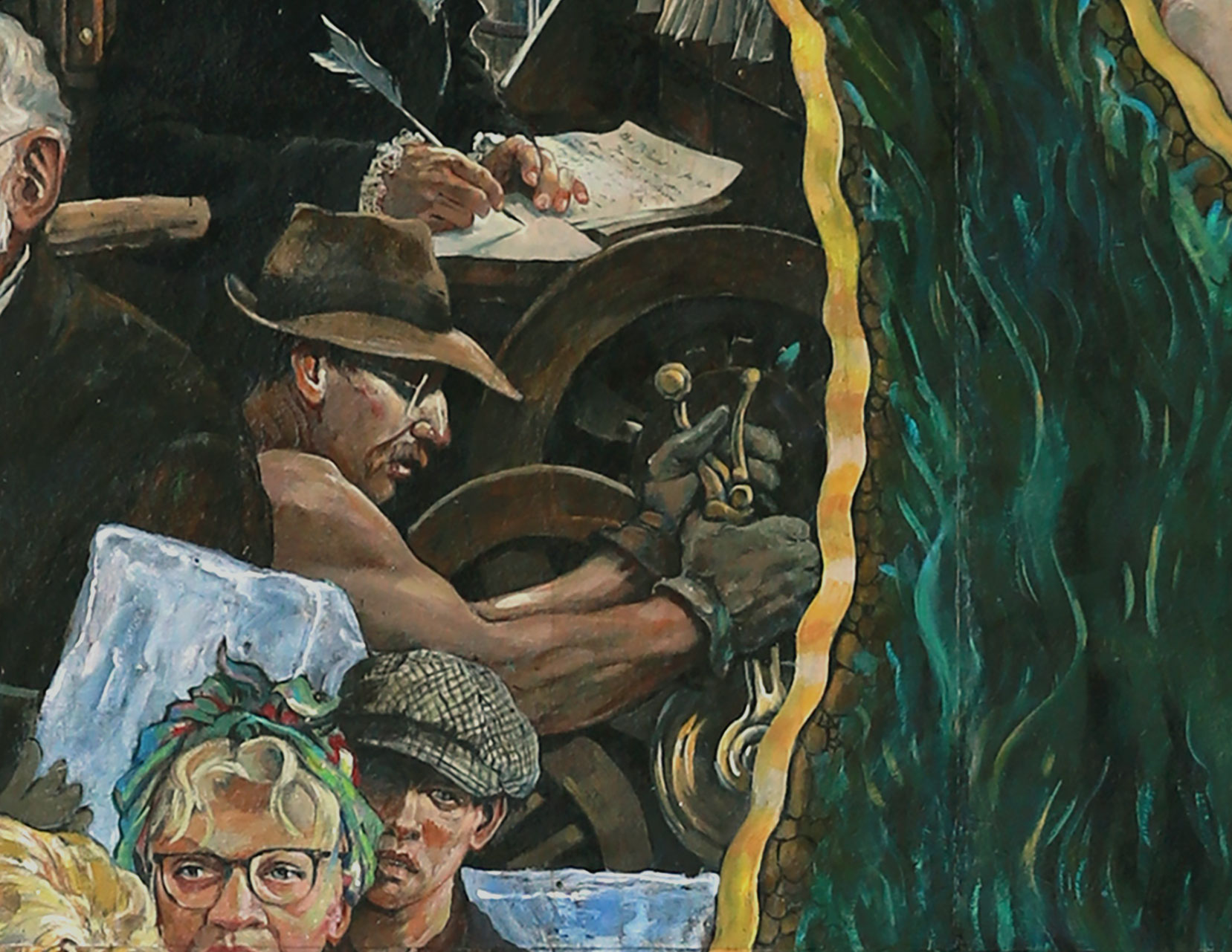
    There were several dams and 9 various mills #30 on Vaughan stream in Hallowell.

    Brothers Charles and Benjamin Vaughan built a flour mill using water power from their stream in 1793.

    Over the years the stream powered an iron works, a machine shop, lumber mill and sandpaper mill at Sheppards Point at the southern end of Hallowell.

    I represented the mills on Vaughan stream by having large millwork gears next to the flowing symbolic river.

    artist, Chris Cart

    3 dams on the stream

    In 1870 Henry Harding opened the Kennebec Wire Company #53 on Vaughan Stream. He imported huge coils of 1/4 inch wire from Boston and Portland. The wire was then run through the mill to create smaller dimension wire for use.

    Benjamin Tenney, who also became Hallowell mayor, ran a Sandpaper mill on the stream.

    Later Hallowell Light and Power used water power to generate electricity for the industry and houses in the area.

    In the 1850s, the company of Prescott & Fuller Iron Foundry was formed on Milliken’s Crossing, in Hallowell, Maine. The founder was Mr. J.P. Flagg, and the owner was George Fuller who also owned Machinists Manufacturers.

    Olympia Farrar #35 posed for the young woman at the industrial loom. The textile mill employed many children.

    wire, wood, grains

    Shoe factory, boots for soldiers with notes…

    The 252 foot long, four story Cotton Mill #34, built in 1844, still stands in Hallowell. In its heyday of production, around 1866, the mill employed 200 textile workers making fabric for curtains, jeans, dress, coat linings, a vast range of fabrics for daily use.

    In the late 1880’s the southern states that provided the raw cotton, built their own textile mills and this led to the close of Hallowell’s textile industry. The Cotton Mill was shut down in 1890.

    From 1909 to 1915 the first floor was occupied by Electrophone, producing one of the world’s first electric automobile horns.

    Then from 1920 to 1966 the building became a shoe factory.

    One story I was told was that during World War II the shoe factory made boots and factory workers would add notes of encouragement in the boots for the soldiers.

    artist, Chris Cart

    In 1979 the building became The Cotton Mills Apartments when the Advisory Council on Historic Preservation in participation with the Department of Housing and Urban Development approved the conversion of the mill into housing for the elderly.

  • Declaration of Independence

    Declaration of Independence

    broad·sheet
    /ˈbrôdˌSHēt/
    noun
    a large piece of paper usually printed on one side only with information for public distribution; also broadside.
    Uses of the word date from the 16th century. In size most broadsides ranged from approximately 13″ x 16″ also known as “foolscap” size, to over 5 feet in length.

    rare 1776 broadsheet

    Mayor Robert Stubbs #20 is shown holding Hallowell’s rare, original 1776 broadsheet of the Declaration of Independence #21.

    The Continental Congress adopted the Declaration of Independence on July 4, 1776 and then ordered Ezekiel Russell, a printer in Salem Massachusetts to print 250 of these broadside copies of the Declaration for distribution around the colonies. Only 11 of these broadsheets are known to exist today.

    The broadsheets were circulated to churches and meeting halls across the 13 colonies. The broadsheets were to be read aloud so the citizens could know that America was declared sovereign lands, no longer under rule of the British monarchy.

    Three of these now rare documents were originally sent to Maine, one to North Yarmouth and one to Fort Western in what is now Augusta, Maine, but in 1776 was still part of Hallowell.

    According to one 1870 history of the region, the Fort Western copy was proclaimed throughout Hallowell and Gardiner, but apparently was never returned to Fort Western.

    The document disappeared for over 100 years, only resurfacing in 1908 when Hallowell native E.T. Getchell donated the broadsheet to the small museum in Hallowell’s Hubbard Free Library, what is now the children’s section of the library.

    found in the library

    Then the rare document had essentially disappeared again. However, in 1976, 200 years after the signing of the Declaration of Independence, our Hallowell historian Sam Webber #41, found the broadsheet, framed and tucked away in the library.

    The Hallowell broadsheet was loaned to Maine State Museum for an exhibit from 1990 to 1993. Later an agreement was reached for the document to be owned by the residents of Hallowell but permanently preserved anmd housed in the Maine State Museum.

    The rare broadsheet is estimated to be valued at $1.6 million.

    On rare occasions the document is brought to Hallowell for public display. Sandy and Bob Stubbs were instrumental in making this happen the last time on July 4, 2015. As part of the July 4th celebrations various Hallowell residents read from the broadsheet Declaration to a public gathering at City Hall.

    photo of Hallowell’s copy of the Declaration of Independence broadside.

    Elisa Clark Lowell

    Elisa Clark Lowell was a direct descendant of the Deacon Pease Clark #109, the family of European descent to build a home on Hallowell shores.

    In 1897 Elisa Clark Lowell donated $10,000 for an addition to the Hubbard Free Library to be dedicated as a small city museum. This is now the children’s section in the library. She attended the dedication the next year at the age of 97.

    Eliza then donated $20,000 to build a new City Hall, saying, “Build it strong that it may last for years to come.” While she saw it under construction, unfortunately, Eliza Clark Lowell died shortly before the building was dedicated in 1898.