Author: admin

  • Cotton Mill

    Cotton Mill

    Olympia Farrar #35 posed for the young woman working at the industrial loom.

    Mills across Maine employed many children as young as 5 for tasks deemed appropriate for children, requiring less strength or skill. In the textile industry children held various jobs:

    • sweepers: keeping the floors clean of fabric scraps and cotton fibers was hard but essential.
    • doffers: placing empty bobbins in the spinning frame to fill with thread
    • quillers: loading hoppers with empty loom quills which would be wound with thread and taken back to the shuttles of the large looms.
    • spinners: often a job for young girls or women, winding strands of thread into fine yarn onto bobbins.

    fabric, fabric, more fabric

    The 252 foot long, four story Cotton Mill #34, built in 1844, still stands in Hallowell. In its heyday of production, around 1866, the mill employed 200 textile workers making fabric for curtains, jeans, dress, coat linings, a vast range of fabrics for daily use.

    In the late 1880’s the southern states that provided the raw cotton, built their own textile mills and this led to the close of Hallowell’s textile industry. The Cotton Mill was shut down in 1890.

    From 1909 to 1915 the first floor was occupied by Electrophone, producing one of the world’s first electric automobile horns.

    Then from 1920 to 1966 the building became a shoe factory.

    One story I was told was that during World War II the shoe factory made boots and factory workers would add notes of encouragement in the boots for the soldiers.

    artist, Chris Cart

    In 1979 the building became The Cotton Mill Apartments when the Advisory Council on Historic Preservation in participation with the Department of Housing and Urban Development approved the conversion of the mill into housing for the elderly.

  • Shoe Factories

    Shoe Factories

    Johnson Brothers Shoes

    Twin brothers William C. Johnson and Richardson M. Johnson opened their Johnson Brothers Shoe factory in 1887 in Hallowell.

    The original building, which faced south on Central Street, was constructed of wood with a brick foundation. The building was expanded by two wings in 1894, extending it to the railroad tracks on the west and to Second Street on the east. The factory, which produced ladies’ shoes of various styles, was very successful and was a major employer in Hallowell. The Johnson business was closed in April of 1927, and the building was occupied by the Kennebec Shoe Company from 1934 to 1953. The abandoned building was torn down in May 1955.

    One story I was told was that during World War II the shoe factory made boots and factory workers would add notes of encouragement in the boots for the soldiers.

    artist, Chris Cart

    12,000 boots

    The factory made 10,000 to 12,000 pairs of boots and 7,000 to 8,000 pairs of shoes per year with thirty to forty people.  In July 1964, new machinery was installed, which made shoemaking faster and easier.  As a result, there were 300 people employed.

    The factory’s weekly payroll was $6,000, and annual sales of ladies shoes was $1,600,000. These were quality all leather shoes using “2,000 leather sides, seventy five dozens of calf skins, three to four tons of split leather, and ten to twelve tons of sole leather.”

    In 1920 the Cotton Mills building also became a shoe factory. It was a thriving shoe business until 1966.

    local models

    Olympia Farrar #35, is shown as a young girl working in the textile mills.

    Murky Lester #37, is shown at a factory sewing maching.

    It was great having so many local models for the various figures in the mural.

    artist, Chris Cart
  • Hallowell industry

    Hallowell industry

    wire, wood, grains

    There were several dams and 9 various mills #30 on Vaughan stream in Hallowell.

    Brothers Charles and Benjamin Vaughan built a flour mill using water power from their stream in 1793.

    Over the years the stream powered an iron works, a machine shop, lumber mill and sandpaper mill at Sheppards Point at the southern end of Hallowell.

    I represented the mills on Vaughan stream by having large millwork gears next to the flowing symbolic river.

    artist, Chris Cart

    3 dams on the stream

    In 1870 Henry Harding opened the Kennebec Wire Company #53 on Vaughan Stream. He imported huge coils of 1/4 inch wire from Boston and Portland. The wire was then run through the mill to create smaller dimension wire for use.

    Benjamin Tenney, who also became Hallowell mayor, ran a Sandpaper mill on the stream.

    Later Hallowell Light and Power used water power to generate electricity for the industry and houses in the area.

    In the 1850s, the company of Prescott & Fuller Iron Foundry was formed on Milliken’s Crossing, in Hallowell, Maine. The founder was Mr. J.P. Flagg, and the owner was George Fuller who also owned Machinists Manufacturers.

    Olympia Farrar #35 posed for the young woman at the industrial loom. The textile mill employed many children.

    wire, wood, grains

    Shoe factory, boots for soldiers with notes…

    The 252 foot long, four story Cotton Mill #34, built in 1844, still stands in Hallowell. In its heyday of production, around 1866, the mill employed 200 textile workers making fabric for curtains, jeans, dress, coat linings, a vast range of fabrics for daily use.

    In the late 1880’s the southern states that provided the raw cotton, built their own textile mills and this led to the close of Hallowell’s textile industry. The Cotton Mill was shut down in 1890.

    From 1909 to 1915 the first floor was occupied by Electrophone, producing one of the world’s first electric automobile horns.

    Then from 1920 to 1966 the building became a shoe factory.

    One story I was told was that during World War II the shoe factory made boots and factory workers would add notes of encouragement in the boots for the soldiers.

    artist, Chris Cart

    In 1979 the building became The Cotton Mills Apartments when the Advisory Council on Historic Preservation in participation with the Department of Housing and Urban Development approved the conversion of the mill into housing for the elderly.
  • Declaration of Independence

    Declaration of Independence

    broad·sheet
    /ˈbrôdˌSHēt/
    noun
    a large piece of paper usually printed on one side only with information for public distribution; also broadside.
    Uses of the word date from the 16th century. In size most broadsides ranged from approximately 13″ x 16″ also known as “foolscap” size, to over 5 feet in length.

    rare 1776 broadsheet

    Mayor Robert Stubbs #20 is shown holding Hallowell’s rare, original 1776 broadsheet of the Declaration of Independence #21.

    The Continental Congress adopted the Declaration of Independence on July 4, 1776 and then ordered Ezekiel Russell, a printer in Salem Massachusetts to print 250 of these broadside copies of the Declaration for distribution around the colonies. Only 11 of these broadsheets are known to exist today.

    The broadsheets were circulated to churches and meeting halls across the 13 colonies. The broadsheets were to be read aloud so the citizens could know that America was declared sovereign lands, no longer under rule of the British monarchy.

    Three of these now rare documents were originally sent to Maine, one to North Yarmouth and one to Fort Western in what is now Augusta, Maine, but in 1776 was still part of Hallowell.

    According to one 1870 history of the region, the Fort Western copy was proclaimed throughout Hallowell and Gardiner, but apparently was never returned to Fort Western.

    The document disappeared for over 100 years, only resurfacing in 1908 when Hallowell native E.T. Getchell donated the broadsheet to the small museum in Hallowell’s Hubbard Free Library, what is now the children’s section of the library.

    found in the library

    Then the rare document had essentially disappeared again. However, in 1976, 200 years after the signing of the Declaration of Independence, our Hallowell historian Sam Webber #41, found the broadsheet, framed and tucked away in the library.

    The Hallowell broadsheet was loaned to Maine State Museum for an exhibit from 1990 to 1993. Later an agreement was reached for the document to be owned by the residents of Hallowell but permanently preserved anmd housed in the Maine State Museum.

    The rare broadsheet is estimated to be valued at $1.6 million.

    On rare occasions the document is brought to Hallowell for public display. Sandy and Bob Stubbs were instrumental in making this happen the last time on July 4, 2015. As part of the July 4th celebrations various Hallowell residents read from the broadsheet Declaration to a public gathering at City Hall.

    photo of Hallowell’s copy of the Declaration of Independence broadside.

    Elisa Clark Lowell

    Elisa Clark Lowell was a direct descendant of the Deacon Pease Clark #109, the family of European descent to build a home on Hallowell shores.

    In 1897 Elisa Clark Lowell donated $10,000 for an addition to the Hubbard Free Library to be dedicated as a small city museum. This is now the children’s section in the library. She attended the dedication the next year at the age of 97.

    Eliza then donated $20,000 to build a new City Hall, saying, “Build it strong that it may last for years to come.” While she saw it under construction, unfortunately, Eliza Clark Lowell died shortly before the building was dedicated in 1898. 

  • Hallowell Mayors

    Hallowell Mayors

    Timson #17, Walker #18, Harmon #19, Stubbs #20,

    several key mayors

    Several recent Hallowell Mayors are shown here, Robert Stubbs, Harvey Harmon, Barry Timson, Mark Walker and George Lapointe.

    Mayor Robert Stubbs #20, is wearing a SAVE HALLOWELL t-shirt. In the 1975 Maine Department of Transportation wanted to widen Route 201 through Hallowell—an act that would have razed many of Hallowell’s historic downtown buildings. Stubbs, the mayor of the time was one of many Hallowellians, calling themselves The Patriots, who fought to preserve the downtown.

    Stubbs is also holding Hallowell’s rare, original broadsheet from 1776 of the Declaration of Independence. Only 250 of these copies of the new Declaration were printed and distributed around the new nation. This rare document was found framed in storage in the Hubbard Free Library in Hallowell. Hallowell’s copy of the Declaration of Independence is now housed at the Maine State Museum.

    I chose these mayors to represent the long list of Hallowell Mayors as they were considered to have contributed a lot to the city during their terms in office.

    artist, Chris Cart

    Mayor Barry Timson #17, was a pillar of the Hallowell community. He served 3 terms as mayor as well as years on the Planning Board, the Water and Sewer District Board, and the Hallowell Water District. He was instrumental in setting up Hallowell’s Head Start program and Hallowell Food Bank.

    Mayor Charlotte Warren #47 served as Hallowell mayor for 5 years. After that she served for four terms in the Maine House of Representatives. and 8 years on the Legislature’s Criminal Justice and Public Safety Committee. Warren previously served on the Judiciary Committee and as the house chair of Maine’s Mental Health Working Group and the house chair of the Commission to Examine Reestablishing Parole. Charlotte is a social worker and an educator.

    Mayor Mark Walker#18, a lawyer, was elected mayor of Hallowell in 2013 and serve 7 years in that position. Before his election, Walker had served on the City Council since 2006. During that time, Walker said that Hallowell has seen “a lot of change and a lot of development.”

    Mayor George LaPointe #68 was the mayor during the majority of the time the mural was being painted.

    Harmon D. Harvey #19, was mayor of Hallowell from January 1990 – January 1996. Then he served as Councilor at Large from January 1999 – January 2002 and prior he had served as Councilor for Ward Five from January 1977 – January 1987.

    Mr. Harvey oversaw the acquisition of the Jamies Pond Wildlife Refuge and was instrumental in arranging for the location of the William S Cohen Center in Hallowell.

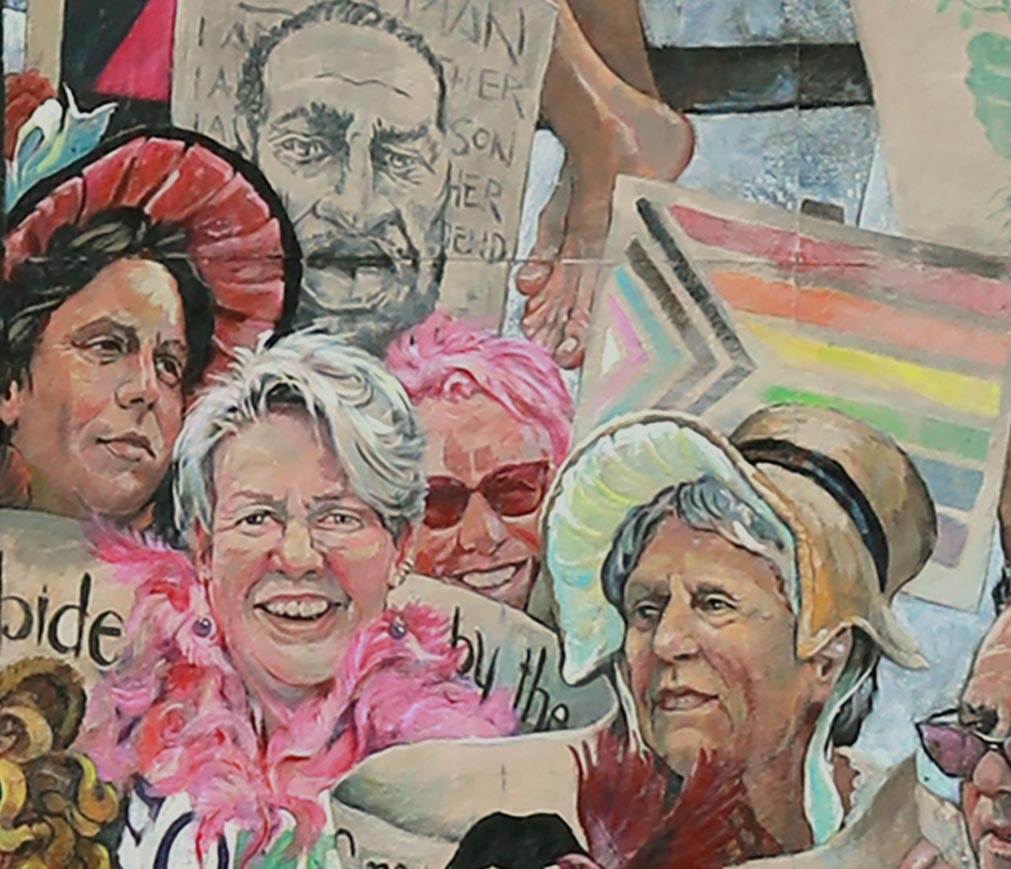
    Charlotte Warren, #47 in the sun glasses behind Betsy Sweet #48 and Libby Thompson #46
    George LaPointe #68
  • those who serve

    those who serve

    national service

    Men and women of Hallowell have served in all the major wars in our nation’s history.

    Mark Francis Bastey, #24, US Army Major, served in Vietnam and received the Purple Heart. He was also awarded the Silver Star for gallantry in action and 2 Bronze Stars.  

    His dates of service are June 1969 to May 1984.  He was medically retired from the Army due to the MS diagnoses.  After retiring from the Army, Mark worked for the Maine Department of Labor as a Veteran’s Counselor.

    Ernest “Bev” Bevilacqua, #25, joined the Navy at 17 and served on several battleships as a gunner’s mate in World War II. He was blown off one into the sea. After the war his ship was stationed just 10 miles off Bikini during the nuclear testing.

    Bev was not from Hallowell but he was my dearest friend. He died in 2019. I included him young in his Navy cracker jacks as a memory.

    artist, Chris Cart

    Brian King #22, served in our modern era.

    Local models

    Diana Gibson, #43, a descendent of the Vaughan family, is shown in the mural. She served in the Red Cross in World War II.

    Of the many Hallowell men #23 who served in the Civil War 45 died fighting for the freedom of others. You can see the large obelisk monument for these fallen soldiers in the Hallowell cemetery.

    Diana Gibson, #43 in mural
    Civil War Memorial, Hallowell Cemetery
  • Governor Bodwell

    Governor Bodwell

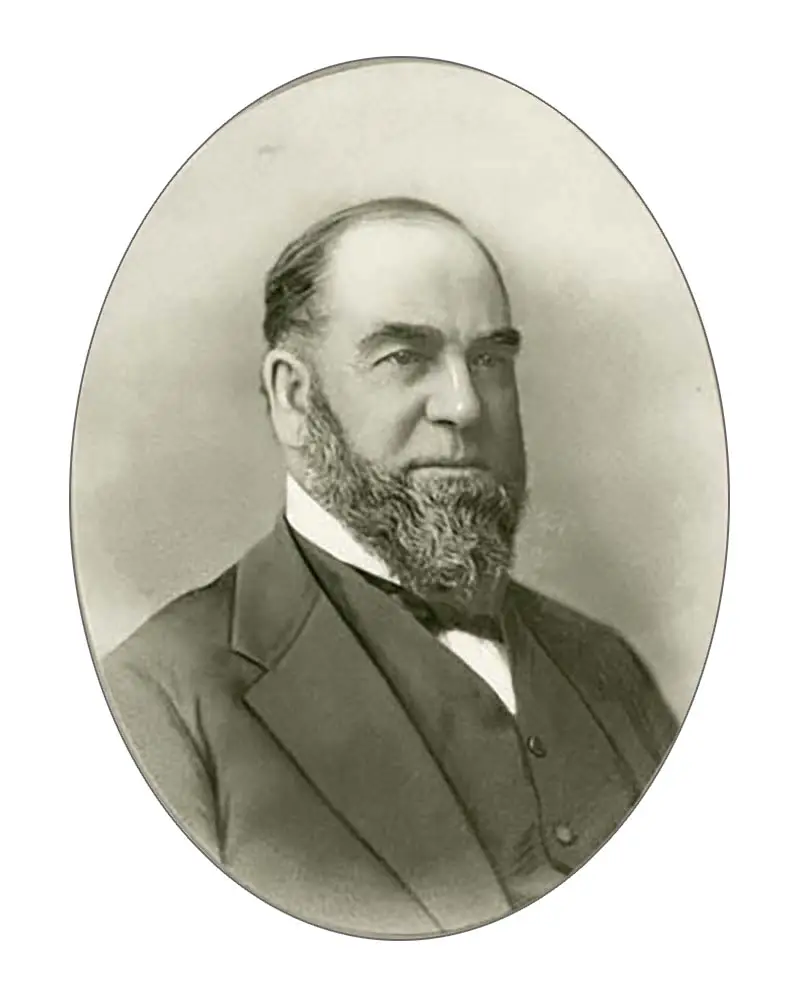
    Governor Bodwell in black coat with grey waistcoat.

    Joseph Robinson Bodwell | 40th Governor of Maine

    (June 18, 1818 – December 15, 1887) Politician

    Joseph R. Bodwell #16, was first elected Mayor of Hallowell in 1869 and served two terms.  He also represented Hallowell in the Maine legislature.

    In 1886 he was elected the 40th Governor of Maine, the second Governor from Hallowell.  While in office he advocated to improve child welfare and labor conditions for workers in Maine’s industries. He served until his death on December 15, 1887.

    Granite industry

    In his 20’s, Joseph Bodwell and his father bought and worked a farm in West Methuen, MA.  During this time period young Bodwell was also engaged to haul a large amount of stone from the quarries in Pelham, New Hampshire to improve the dam on the Merrimack River at Lawrence, MA.  This was his introduction to all aspects of the stone quarrying industry.

    Successful businessman

    Bodwell also had business interests in lumbering, agriculture, live stock and the important ice business.

    Bodwell eventually became the owner of two stone companies, opening granite quarries on Vinalhaven in 1852 and opening the Hallowell Granite Company in 1866.  The company was reorganized as the Hallowell Granite Works in 1885 becoming one of the largest granite producers in the United States.

    He is buried in the Hallowell Cemetery.

    Governor Bodwell Mansion is newly restored on Middle Street in Hallowell. This photo if c1900.
    Bodwell mansion as seen today.
  • Granite and Quarrymen

    Granite and Quarrymen

    A slab of quarried granite to be sent to Boston to make the cornice stones at Quincy Market.
    A slab of quarried granite being hauled by horses on wagon called galamander.
    A ship being loaded with granite on Hallowell’s riverfront.

    famous monuments of the nation

    Hallowell granite was prized for its light color and fine grain. It has a high percentage of feldspar which made it relatively easy to quarry and carve—relative, but still not easy since it is granite after all. When properly dress by the sculptor it shines almost as white as marble and when polished the surface can glitter like diamonds. It is beautiful stone.

    Hallowell granite was used for many of America’s most important monuments—as well as local doorsteps and foundations still seen around town. The cornice stones for Boston’s Quincy Market were cut from John Hain’s Hallowell quarry, shipped down the Kennebec and cut and placed starting in 1815.

    Eight to ten teams of horses and oxen hauled the granite loaded onto heavy wagons, called galamanders. Once quarried and carved locally the granite was carefully crated for transport in wood from the local lumber mills.

    Granite was shipped by rail and by ship down the Kennebec.

    The Hall of Records and the Metropolitan Art Museum in New York City were built using Hallowell Granite. Hallowell had huge granite contracts for Chicago’s Marshall Field Building and the Post Office in Chicago, Ill. were large contracts. The largest contract was for the State Capitol at Albany, NY, from 1867-1898, totaling 25 million dollars.

    Hallowell granite was used to build the Maine State House, the Kennebec Arsenal, and the Maine Insane Hospital in Augusta.

    Who were the stone carvers and quarrymen?

    Stone cutters and quarrymen came from Italy, England, Spain, Scotland and Canada to work in Hallowell’s thriving granite industry.

    In 1901 a skilled Maine granite cutter could earn between $2.80 to $3.20 a day. This was a solid middle class income at the time. Quarrymen tended to earn between $1.75 and $2.00 per day.

    Tony (Masciadri) was a huge help to me, showing me traditional stone cutting and carving tools and demonstrating the proper way yo use them so I could depict the action in the mural.

    artist, Chris Cart

    Protasio Neri

    Protasio Neri was one prominent Hallowell stone carver. Born in Levigliani, Italy, he was trained in stone carving in the marble quarries of Carrara, the quarries famous for the marble Michaelangelo preferreds. Protasio moved with his family to 1877 at age 27 to pursue his granite carving career in Hallowell. Neri was very involved in unionizing the stone carvers to improve their working conditions.

    William Rich

    Another granite worker, William Rich, came from Cornwall, England to work the Bodwell quarry in 1872. He was a gifted stone carver who worked carving the statue of “Faith,” statue that sits atop the national Monument to the Forefathers now in Plymouth, Massachusetts. Locally in Hallowell, you can see his carving over the door of the Hubbard Free Library.

    Settimio Masciadri

    Settimo Masciadri came from Italy near Lake Como, in 1895 when Governor Joseph Bodwell’s company Hallowell Granite Works sent out a worldwide call for stone carvers.

    Settimio worked for Bodwell for 5 years and got his United States citizenship. He returned to Italy and married his girlfriend. They returned in 1902 where their son Americo, Tony Masciadri’s father, was born.

    Americo grew up working stone like his father. He also worked for the WPA for a time. Then Americo and Joe Perrazi bought Kennebec Monument which eventually became the Masciadri & Sons Monument that we know today.

    In the 1970’s Tony Masciadri came back to town to assist his father in the family stone monument business. He stayed on to take over the business. He only recently retired in 2023. Though he still does some work at the shop.

    Protasio Neri
    Letters carved by William Rich
  • National Monument to the Forefathers

    National Monument to the Forefathers

    Faith, 36 foot sculpture

    The National Monument to the Forefathers #27, formerly known as the Pilgrim Monument, commemorates the Mayflower Pilgrims. Dedicated on August 1, 1889, it honors their ideals as later generally embraced by the United States. It is thought to be the nation’s largest solid granite monument.

    Carved of local granite in Hallowell in the site of the current Camden National Bank

    The “Faith” statue, modelled after the sculptor Hammatt Billings’ mother, stands atop a 45 foot pedestal and ringed by 4 additional figurative sculptures.

    This sculpture was central to the early sketches of the mural.

    artist, Chris Cart

    Carved in Hallowell

    Located at 72 Allerton Street in Plymouth, Massachusetts, the 81-foot-tall (25 m) monument was commissioned by the Pilgrim Society. The 36 foot solid granite Faith figure stands on a 45 foot granite pedestal. The original concept dates to around 1820, with actual planning beginning in 1850. The cornerstone was laid August 2, 1859 by the Grand Lodge of Masons in Massachusetts, under the direction of Grand Master John T. Heard. The monument was completed in October 1888, and was dedicated with appropriate ceremonies on August 1, 1889.

    Photo by By T.S. Custadio aka ToddC4176 at en.wikipedia – Transferred from en.wikipedia to Commons by User:Kelly using CommonsHelper., Public Domain, https://commons.wikimedia.org/w/index.php?curid=16091399

    Hallowell stonecutters, Hallowell Granite

    Statuary cutter Joseph Archie stands on Faith’s outstretched arm. He was the primary cutter and Italian immigrant, Prostasio Neri, supervised the carving of base statues Morality, Education, Law and Liberty. Although the statue appears solid, it was carved in sections and most likely transported to Plymouth in one of the two large ships owned by the Hallowell Granite Works.

    The photo was taken in the cutting yard on Franklin Street and the one-time steeple of the Baptist church can be seen in the background.

    Creating the granite texture in this large sculpture and the other granite elements in the mural design took a lot of work layering close colors and splattering fine paint drips. Any simpler rolled or brushed texture technique ended up looking like concrete rather than Hallowell’s elegant white granite.

    …a lot of work but I think worth it.

    artist, Chris Cart

    local heritage

    Tony Masciadri, #26, shown on the right with the heavy hammer is the owner of S Masciadri & Sons Monuments in Hallowell. Tony is the direct descendant of some of Hallowell’s original stone carvers from Italy, Settimio Masciadri. The family stone carving business was passed from grandfather to father to Tony, who has spent his life carving granite in Hallowell.

    Jon Doody, #28, on the left, is a local stone sculptor who carved the granite sturgeon that can be seen today in Granite City Park in Hallowell.

    Jon Doody on left with mallet and chisel, Tony Masciadri on right with heavy stone hammer.

    stone cutters from Italy, Spain and Scotland

    Settimo Masciadri came from Italy near Lake Como, in 1895 when Governor Joseph Bodwell’s company Hallowell Granite Works sent out a worldwide call for stone carvers.

    Settimio worked for Bodwell for 5 years and got his United States citizenship. He returned to Italy and married his girlfriend. They returned in 1902 where their son Americo, Tony Masciadri’s father, was born.

    Americo grew up working stone like his father. He also worked for the WPA for a time. Then Americo and Joe Perrazi bought Kennebec Monument which eventually became the Masciadri & Sons Monument that we know today.

    In the 1970’s Tony Masciadri came back to town to assist his father in the family stone monument business. He stayed on to take over the business. He only recently retired in 2023. Though he still does some work at the shop.

  • Martha Ballard

    Martha Ballard

    midwife and healer

    Martha Ballard #10, (February 9, 1735 – June 9, 1812) was a midwife and healer in early Hallowell .  Born in colonial Massachusetts, not much is known of her early life but at age 50 she began keeping a diary of her midwifery and healing efforts in the Hallowell/Augusta area.

    With thousands of entries over the 27 years she kept a diary, Ballard writes of delivering 816 babies and being present at more than 1,000 births—amazing when you think the entire population of Hallowell in 1790 was 1194 and the end of her life was only just over 3800. Ballard must have delivered or attended births in most families of the time. 

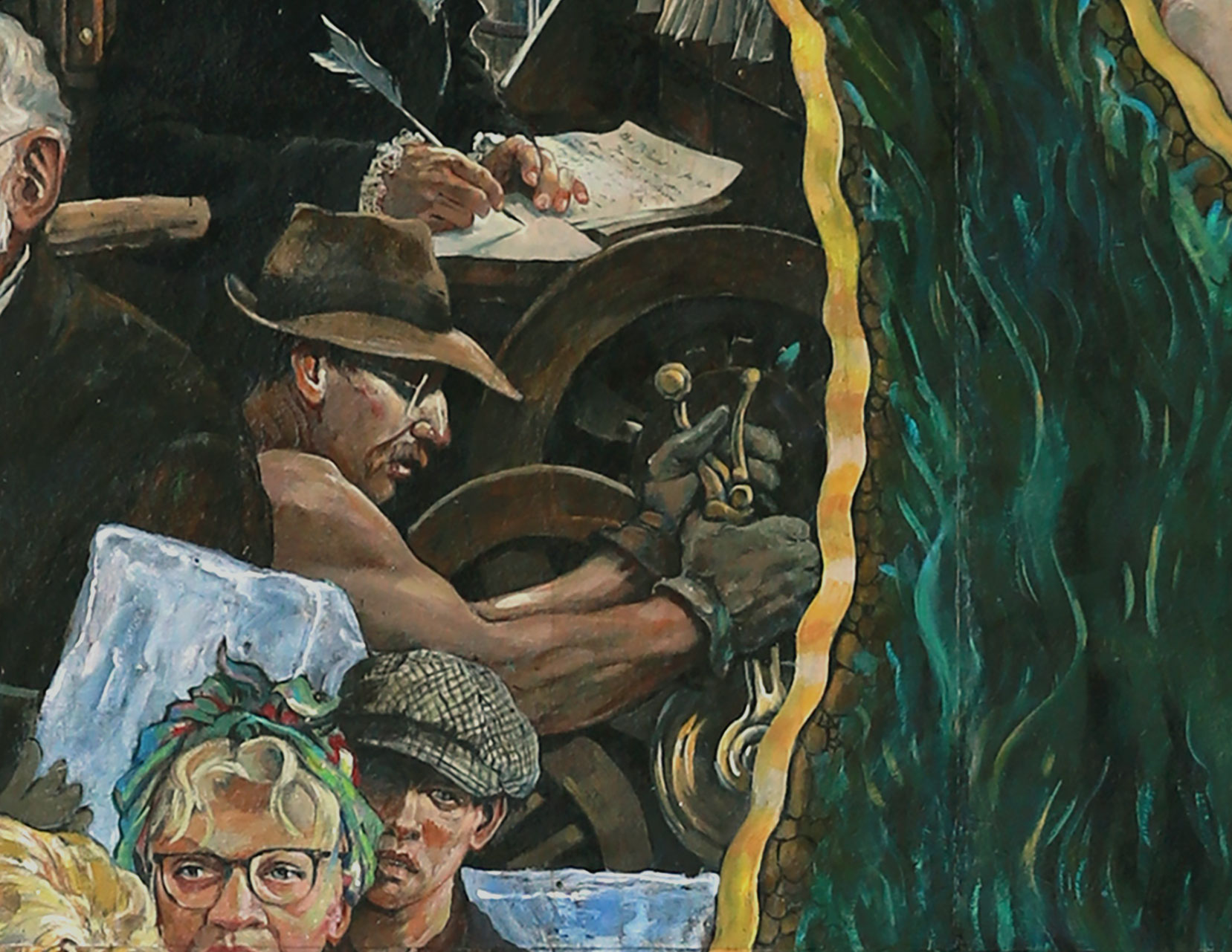
    Behind Ballard in the mural I included a small writing desk with oil lamp, quill pen and paper to commemorate her writings in her diary, which give us a detailed insight into the daily life of the early nation.

    artist, Chris Cart

    In her diary, Ballard also made note of the daily happenings of her patients, their health, sometimes the weather. It is a great resource for minutia of the day to day lives of 18th century Hallowell people.

    local descendant

    The older woman in the glasses is Alice Ballard Buck #9, a local resident who was a direct descendant of Martha Ballard.

    I wanted to have Alice helping her ancestor Martha Ballard with the delivery in this birthing scene. When I asked Alice if she would mind my including her, her whole face lit up—the biggest smile you can imagine.

    artist, Chris Cart

    For further reading Ballard’s diary is a fascinating read, The Diary of Martha Ballard 1785-1812, as is A Midwife’s Tale: The Life of Martha Ballard by Laurel Thatcher Ulrich, based on Ballard’s diary. Both available at libraries and bookstores.

    developing an idea

    I worked a lot in the early sketches of this scene with Martha Ballard. I wanted to show the drama and importance of the days of her life. The crescent shaped space next to the river was challenging to depict the birth scene.

    I painted both Martha Ballard and Benjamin Vaughan in the top center of the mural, opposite each other. This placement was no accident. I felt they both represented different, yet essential aspects of the early life in Hallowell on the wild shores of the Kennebec. Vaughan brought his wealth, his vast library and his associations with the important minds of the time. Ballard’s life was no less important to the daily life with her knowledge of healing, herbal medicines and vast experience as a midwife. Her diary gives us a window into the daily life with all its joy, grief and the neighborly gestures of community.

    artist, Chris Cart

    history of the diary

    Ballard’s diary was more than 1400 pages long, some early entries very short but in her later years her writings became longer and more detailed.

    The last entry, dated May 7th, 1812, a month before her death, ends with the words: “Revd mr Tippin Came and Converst Swetly and made A Prayer adapted to my Case.”

    After her death the diary was kept by the Lambard family for 2 generations, when Sarah and Hannah Lambard gifted the diary to Martha Ballard’s great-great-granddaughter Mary Hobart.

    Mary Hobart was one of the first female physicians to be graduated from the New York Infirmary for Women and Children in 1884. This was the year she was given her ancestor’s diary.

    In 1930 Hobart donated the diary to the Maine State Library, in Augusta, Maine. The diary was referenced in a history of the area in 1961.

    Robert R. McCausland and Cynthia MacAlman McCausland spent ten years transcribing the handwritten diary.

    Historian  Laurel Thatcher Ulrich, seeing the importance of Ballard’s diary as a record of the day to day life of early America, spent 8 years working with the diary. She published A Midwife’s Tale: The Life of Martha Ballard in 1989. The book received much acclaim:

    In 1991, A Midwife’s Tale received the Pulitzer Prize, the Bancroft Prize, the John H. Dunning Prize, the Joan Kelly Memorial Prize in Women’s History, the Berkshire Conference of Women Historians Book Prize, the Society for Historians of the Early Republic Book Prize, the William Henry Welch Medal of the American Association for the History of Medicine, and the New England Historical Association Award.

    In 1997, the PBS series The American Experience aired A Midwife’s Tale a movie documentary based on Martha Ballard’s life and diary and Ulrich’s book.

    Hallowell’s official Historian Sam Webber #41 was a consultant for the movie.

    early study of historian Sam Webber for the mural.